From Data to Harvest: AI-Powered Australian Startups Driving Predictive Agriculture in 2026
A Data Revolution in the Paddock
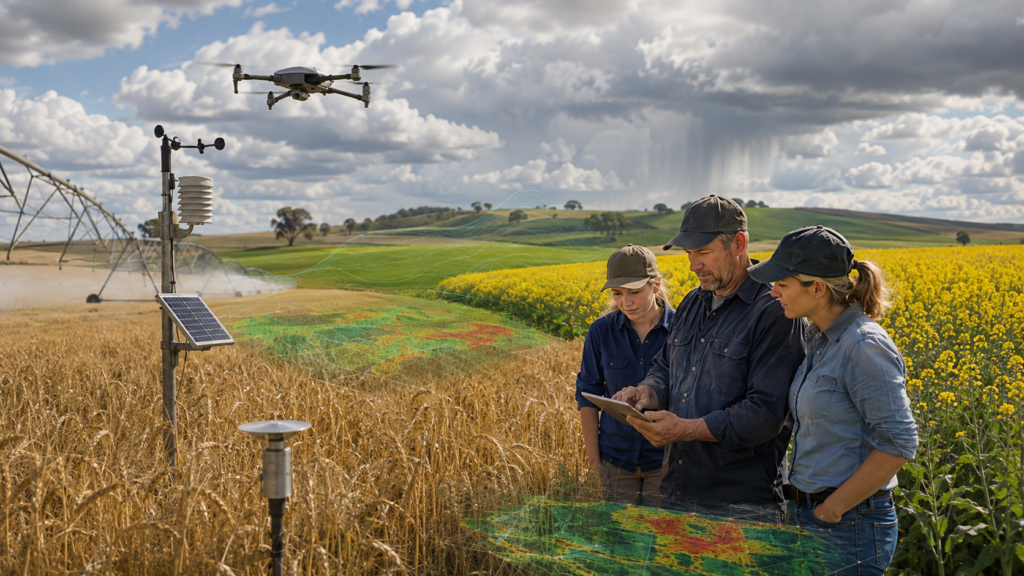
Australian growers have always been at the mercy of volatile weather, but in 2026 they are fighting back with predictive analytics. A wave of AI-driven startups is transforming raw sensor data into actionable forecasts that tell farmers exactly when to plant, irrigate, and harvest. The goal is no longer simply to react to conditions but to anticipate them days or even months in advance.
The CSIRO’s Digital Agriculture 2026 report highlights that farms using predictive platforms have reduced water usage by an average of 18% and increased yield predictability by 27%. (https://www.csiro.au/)
The Yield: From Oyster Leases to Grain Silos
The Yield, a Sydney-founded startup, originally built its reputation by helping Tasmanian oyster farmers predict rainfall-driven estuary closures. Today, its YieldPredict platform has expanded into broadacre cropping, viticulture, and protected cropping. Using a network of hyper-local microclimate sensors, on-farm weather stations, and satellite data, the system applies deep learning to forecast conditions at a field level for the next 10 days.
In 2026, The Yield struck a strategic alliance with Bayer Crop Science to integrate its prediction engine with Bayer’s digital platform FieldView. This gives Australian canola and wheat growers a unified dashboard where they can simulate planting dates, nitrogen applications, and irrigation schedules under different long-range weather scenarios. Early adopters in the Riverina region reported an 11% lift in gross margins, attributed mainly to better timing of pre-emergent herbicide sprays.
FluroSat and the Rise of Hyper-Spectral Analytics
While The Yield focuses on weather, FluroSat (now rebranded as Regrow Ag) specialises in plant-level diagnostics. Its FluroSense platform ingests drone and satellite imagery, including hyperspectral data, to detect crop stress up to two weeks before it becomes visible to the naked eye. Machine learning models trained on more than 15 million hectares of Australian farmland can distinguish between nitrogen deficiency, disease, and waterlogging with 95% accuracy.
In a 2026 pilot with the Grains Research and Development Corporation (GRDC), FluroSat’s algorithms were applied to a network of 200 wheat farms across Western Australia’s wheatbelt. The result: an average 8% reduction in nitrogen fertiliser use without any yield penalty, saving growers an estimated AUD 28 per hectare and cutting nitrous oxide emissions.
Democratising AI for Family Farms
A new wave of “AI-as-a-service” platforms is ensuring these tools are not confined to corporate farms. Farmbot, a monitoring startup, offers a subscription-based water and weather sensor network costing under AUD 1,500 per annum, while Pairtree Intelligence aggregates data from multiple farm software suites into a single AI command centre. These low-barrier solutions are bringing predictive agriculture to the 85% of Australian farms that are family-owned, proving that data literacy can be built one dashboard at a time.