Australia’s Biotechnology Industry in 2026: Market Dynamics, Research Breakthroughs, and the Road Ahead
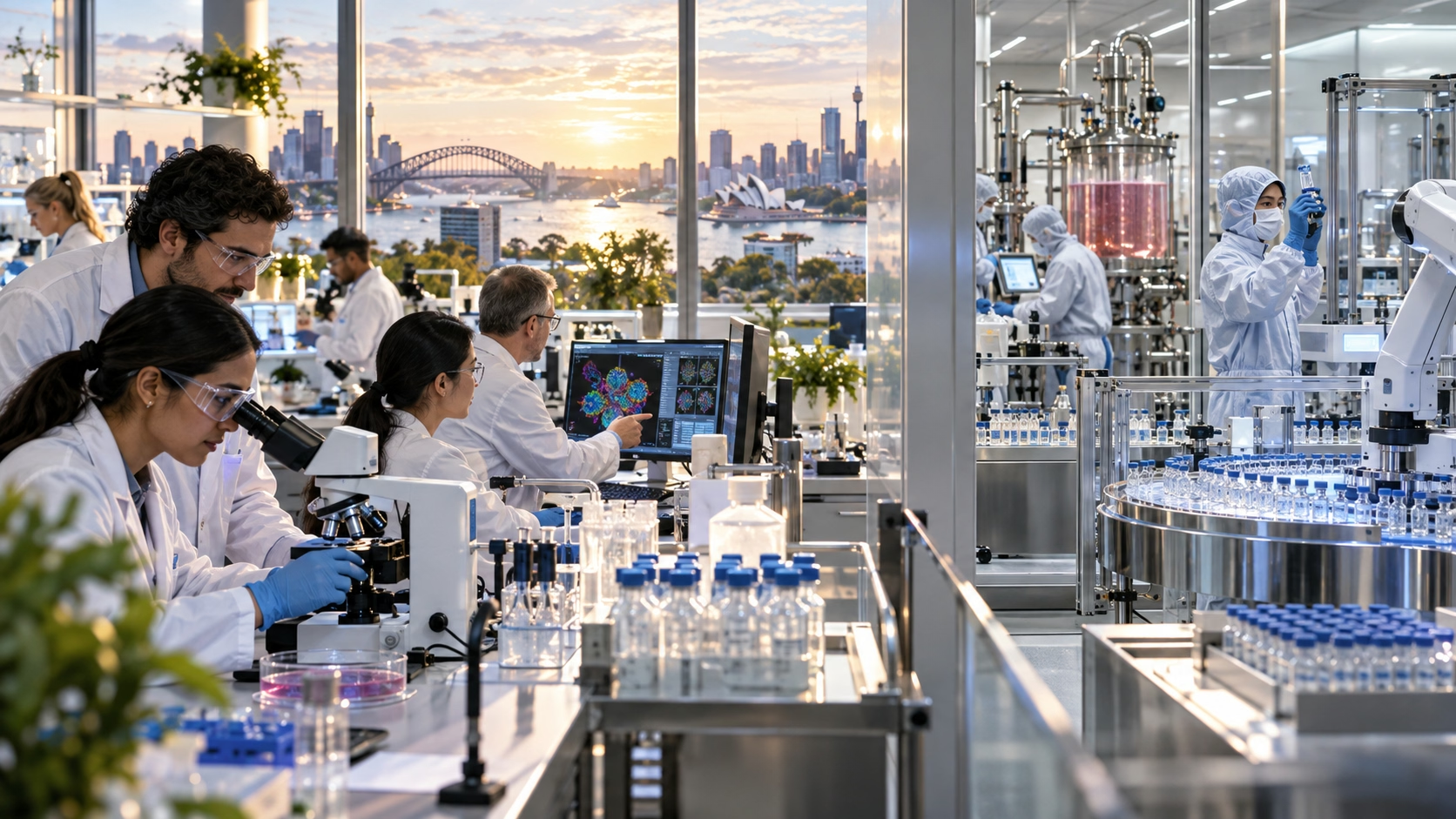
The Scale and Momentum of Australia’s Biotech Ecosystem
Australia’s biotechnology sector has solidified its position as a critical pillar of the national economy, with IBISWorld data placing the industry’s market size at $13.0 billion in 2026, reflecting a compound annual growth rate of 3.2% between 2021 and 2026. This growth trajectory is underpinned by a broader life sciences ecosystem that has doubled in size since 2017, now encompassing approximately 3,000 organisations and supporting one in every 65 jobs nationwide.
The sector’s expansion is not merely quantitative. Australia’s innovators are now securing pharmaceutical patents at levels comparable to Israel and Switzerland, signaling a qualitative shift toward high-value intellectual property generation. This patent intensity reflects a maturing ecosystem where translational research increasingly bridges the gap between laboratory discovery and commercial application.
Research Infrastructure and Translational Capability
The foundational strength of Australian biotechnology lies in its research infrastructure. Institutions such as the Walter and Eliza Hall Institute (WEHI), the Peter MacCallum Cancer Centre, and the University of Queensland have become engines of commercially viable innovation. The Australian Centre for Targeted Therapeutics (ACTT), established with $15 million in Medical Research Future Fund (MRFF) funding, exemplifies this model by bringing together WEHI, the Children’s Cancer Institute, and Monash University to commercialise platform technologies.
Venture capital has responded to this research momentum. Australia’s biotechnology industry attracted an $829 million injection of venture capital in the preceding year, though questions remain about whether the capital stack is sufficiently deep to fully capitalise on global biotech opportunities. This tension between research excellence and capital availability represents one of the sector’s most pressing structural challenges.
Emerging Therapeutic Frontiers
Several therapeutic areas are driving Australia’s biotech narrative in 2026. Radiopharmaceuticals have emerged as a particularly dynamic segment, with Brisbane-based AdvanCell closing a record AUD $450 million Series D round to advance its Lead-212 targeted alpha therapy for prostate cancer. The company’s approach—producing radioactive isotopes at its Brisbane lab without requiring expensive reactors or cyclotrons—represents a genuine manufacturing innovation that addresses industry-wide isotope supply constraints.
Gene editing and cell therapies are also advancing rapidly. Peter MacCallum Cancer Centre’s “precision guided” CAR T-cell therapy, developed using CRISPR gene editing tools, has secured nearly $18 million in MRFF funding to progress to first-in-human clinical trials. This technology engineers CAR T-cells to localise cytokine responses directly into tumour sites, potentially improving efficacy while reducing toxicities in both blood and solid tumour cancers.
Sovereign Manufacturing and Pandemic Preparedness
A defining feature of Australia’s biotech landscape in 2026 is the strategic emphasis on sovereign manufacturing capability. The Moderna Technology Centre – Melbourne (MTC-M) at Monash University’s Clayton campus represents the Southern Hemisphere’s first commercial-scale mRNA manufacturing facility, with capacity to produce up to 100 million vaccine doses annually. Granted its full Good Manufacturing Practice (GMP) licence from the Therapeutic Goods Administration in August 2025, the facility gives Australia end-to-end mRNA production capability—from drug substance through to fill-and-finish.
Victoria has further strengthened its position as a global mRNA hub with BioNTech’s clinical-scale manufacturing facility at La Trobe University’s Bundoora campus, incorporating BioNTainer manufacturing units—modular production systems deployed in only two locations globally outside Germany. These investments signal a deliberate policy shift toward reducing dependence on overseas supply chains for critical medical countermeasures.
Challenges and Structural Considerations
Despite these advances, the sector faces notable headwinds. Australia’s biotechnology import trend experienced a -2.9% decline in growth rate from 2023 to 2024, and the compound annual growth rate for imports between 2020 and 2024 stood at -10.78%. While this may reflect successful import substitution through domestic manufacturing, it also highlights the sector’s exposure to global trade dynamics and supply chain volatility.
Employment in the biotechnology industry reached 24,592 people in 2026, growing at an average of 4.1%. However, talent scarcity in specialised fields such as bioinformatics, regulatory affairs, and advanced manufacturing remains a constraint on scaling operations. The sector’s ability to attract and retain skilled workers will be a critical determinant of whether current investment momentum translates into sustained commercial outcomes.
Future Industry Opportunities
Looking ahead, Australia’s biotech industry is positioned at the intersection of several high-growth global trends. The convergence of AI-driven drug discovery, precision fermentation for food and materials, and next-generation immunotherapy platforms creates multiple pathways for value creation. The CSIRO’s ON program has supported startups that collectively secured over $800 million in funding, demonstrating the pipeline of investable innovations emerging from the public research system.
Australia’s competitive advantage lies not in scale but in agility—the ability to move rapidly from discovery to clinical proof-of-concept. As global pharmaceutical companies confront a $300 billion patent cliff, Australian biotechs with validated assets and sovereign manufacturing capabilities become increasingly attractive acquisition and partnership targets. The challenge for the sector is to capture more of that value domestically rather than exporting intellectual property at the preclinical stage.