Australia’s Spatial Computing Ecosystem Hits $725M in Venture Funding as XR Startups Redefine Enterprise Training
The Silent Revolution Reshaping Australia’s Tech Landscape
Australia’s spatial computing sector has quietly assembled one of the Asia-Pacific region’s most formidable extended reality clusters, with 368 companies now operating across the ecosystem and 74 funded ventures collectively raising $725 million in venture capital and private equity, according to Tracxn’s August 2026 market analysis. The numbers tell a story of maturation rather than hype: 24 companies have progressed to Series A or beyond, one has achieved unicorn status, and the sector has recorded six acquisitions and five initial public offerings.
From Gaming Curiosity to Enterprise Necessity
The centre of gravity in Australian XR has shifted decisively. StartupBlink’s August 2026 rankings place JigSpace, FLAIM Systems, and Plattar at the apex of the country’s VR/AR hierarchy, with an estimated ecosystem value of US$156.8 million based on startup valuations and exits. JigSpace alone has accumulated $22.6 million in funding, powering a 3D presentation platform that counts Medtronic and Hino Trucks among its enterprise users.
Defence Contracts Validate Commercial Viability
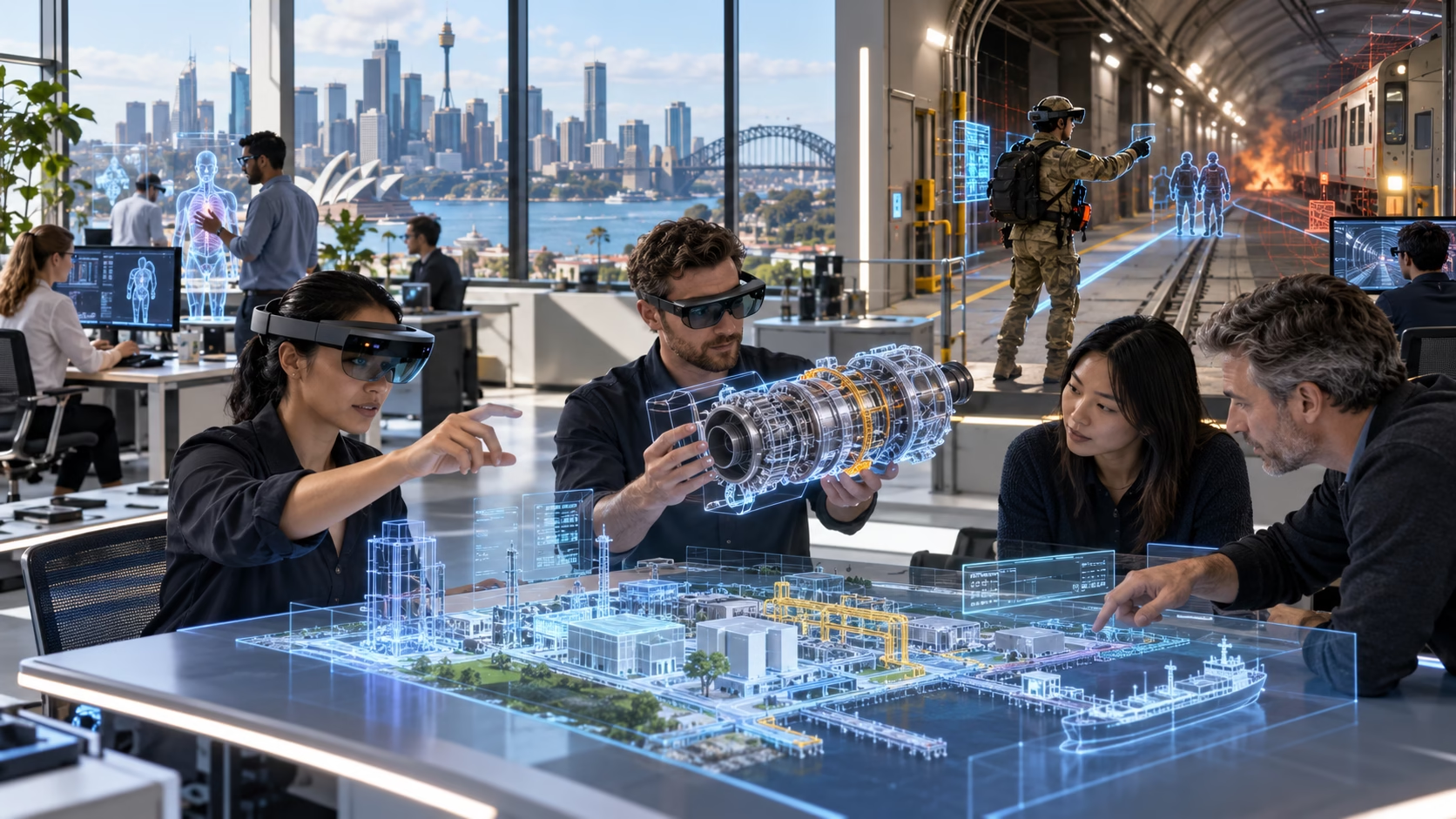
The most striking validation of Australian XR technology came in May 2026, when ASX-listed xReality Group’s Operator XR division completed an AUD $5.6 million contract with the US Department of Defence, delivering extended reality training for subterranean and subway environments. The programme’s completion triggered the commercial launch of MR-1, a mixed reality training system that overlays virtual threats onto physical training sites, from schools to transit hubs.
“Successfully delivering a prototype for the US DoD and having it accepted into end-user training is exactly the outcome we set out to achieve,” said Wayne Jones, Chief Executive Officer of xReality Group. The company has already recorded an initial MR-1 sale to a separate US Department of Defence customer, demonstrating demand beyond the original programme scope.
Government Funding Fuels Next Phase
State-level programmes have provided critical early-stage fuel. Advance Queensland’s support for XR hubs has created innovation pipelines that bridge university research and commercial deployment. Meanwhile, Vection Technologies, a global XR and AI platform provider, secured a $1.2 million government grant from Digital Health R&D programmes in 2026, reinforcing the sector’s pivot toward regulated, high-stakes industries.
Melbourne Emerges as Immersive Tech Capital
Melbourne’s startup density in immersive technologies has attracted international attention. Seedtable’s July 2026 watchlist identifies Metakey and Jigspace as the city’s most promising AR, VR, and metaverse ventures. Jigspace’s Series A status reflects a broader trend: Australian XR startups are no longer confined to seed-stage experimentation but are scaling into organisations capable of serving multinational clients.
What the Data Reveals About 2026 Momentum
The Australian augmented reality market alone is projected to reach US$19.9 billion by 2033, expanding at a compound annual growth rate of 30.9% from 2026, according to Grand View Research. This forecast underscores a fundamental shift: investors and enterprise buyers are treating XR not as a novelty but as core infrastructure for training, simulation, and operational efficiency.