Australia’s Logistics & Transport Companies: Infrastructure and Efficient Solutions
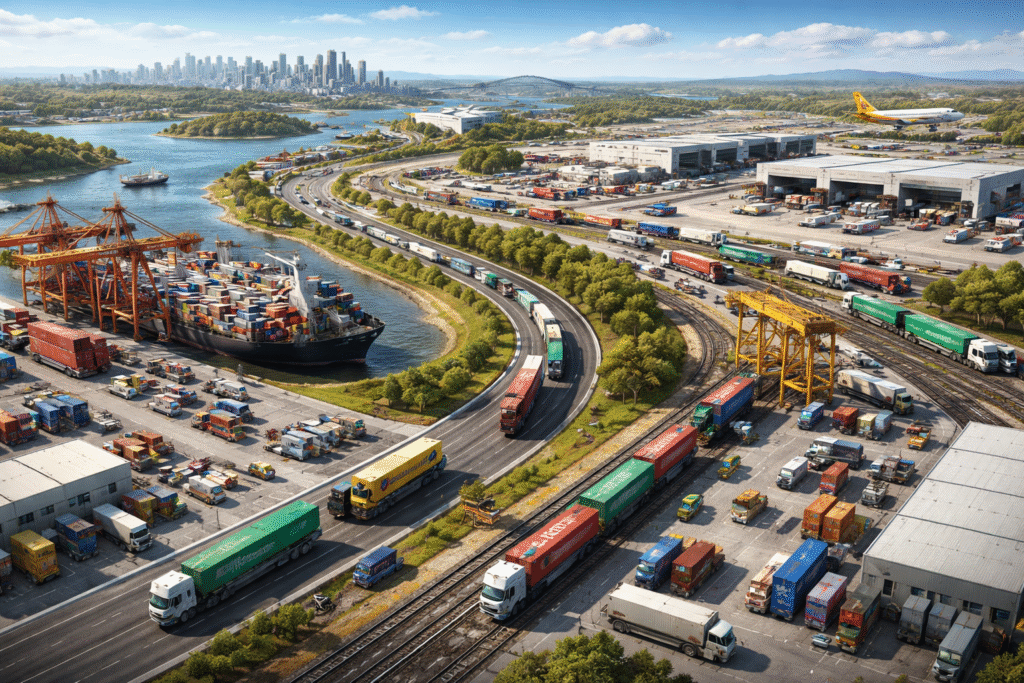
Australia’s logistics sector operates in a uniquely demanding environment: a vast landmass, widely dispersed population centres, and export-heavy supply chains tied to mining, agriculture, and retail. To move goods reliably across these distances, logistics and transportation companies combine strong physical infrastructure—ports, roads, rail, airports, and intermodal terminals—with technology-driven planning, compliance expertise, and specialised services such as cold chain and dangerous goods management.
Core infrastructure that shapes the network
International trade flows through major container ports including Port Botany (Sydney), Port of Melbourne, Port of Brisbane, and Fremantle (Perth), supported by bulk export gateways in regions like Pilbara (iron ore) and Queensland coal terminals. Logistics providers build “port-centric” operations around these hubs: container unpack (deconsolidation), quarantine-aware handling, bonded storage, and rapid transfer to road or rail for domestic distribution.
On land, long-haul freight relies on national highways and key freight corridors connecting east-coast capitals and regional centres. Rail also plays a critical role for heavy and linehaul volumes. Operators such as Aurizon and Pacific National (among others active in rail freight) support bulk and intermodal services, while private intermodal terminals enable container transfers between truck and train. For time-sensitive freight—medical products, aircraft parts, or e-commerce priority shipments—air cargo capacity through major airports (Sydney, Melbourne, Brisbane, Perth) becomes essential, often coordinated by integrators and freight forwarders.
Major company types and what they deliver
Australia’s market is served by several categories of players:
- Integrated domestic providers (e.g., Toll, Linfox, Team Global Express and other large carriers) that offer warehousing, linehaul, and distribution under one umbrella. These companies typically run multi-client distribution centres near capital cities, cross-docks for rapid sortation, and dedicated fleets for retail and industrial customers.
- Parcel and last-mile networks led by Australia Post and private couriers, increasingly shaped by e-commerce expectations such as predictive delivery windows, parcel lockers, and returns management.
- Global freight forwarders and integrators (commonly including DHL, DB Schenker, Kuehne+Nagel, UPS and similar firms) that coordinate international freight, customs brokerage, and multimodal routing. Their value is in carrier contracting, visibility, and compliance rather than only owning trucks.
Efficiency solutions beyond trucks and warehouses
Modern efficiency is built on data and process discipline. Transport Management Systems (TMS) help companies plan routes, consolidate loads, schedule pickups, and automate invoicing. Warehouse Management Systems (WMS) optimise storage locations, wave picking, and cycle counts. Increasingly, providers deploy telematics and IoT sensors to track temperature, shock, and dwell time—critical for pharmaceuticals, meat and seafood exports, and sensitive electronics.
Intermodal strategies are also central: shifting suitable long-haul freight from road to rail can reduce congestion and stabilise transit times, while keeping trucks for first/last-mile legs. Many firms use cross-docking to avoid unnecessary storage—freight arrives, is sorted, and departs quickly—reducing handling and inventory holding costs.
Compliance, resilience, and sustainability
Operating in Australia requires careful attention to biosecurity controls, dangerous goods rules, fatigue management, and chain-of-responsibility obligations. Strong providers invest in driver training, audited processes, and documented handling to protect service continuity. Resilience planning is equally important: bushfires, floods, and port disruptions can force rapid rerouting and temporary warehousing.
Sustainability is rising in procurement decisions. Companies are trialling electric delivery vehicles for metro routes, using route optimisation to cut empty kilometres, and adopting renewable-powered warehouses where viable.
The most effective logistics and transport providers in Australia are those that blend infrastructure access with digital visibility, compliance strength, and flexible multimodal design—so freight keeps moving efficiently across one of the world’s most challenging operating landscapes.