From Paddock to Plate: How Australian Restaurants Are Leading the Global Farm-to-Table Revolution in 2026
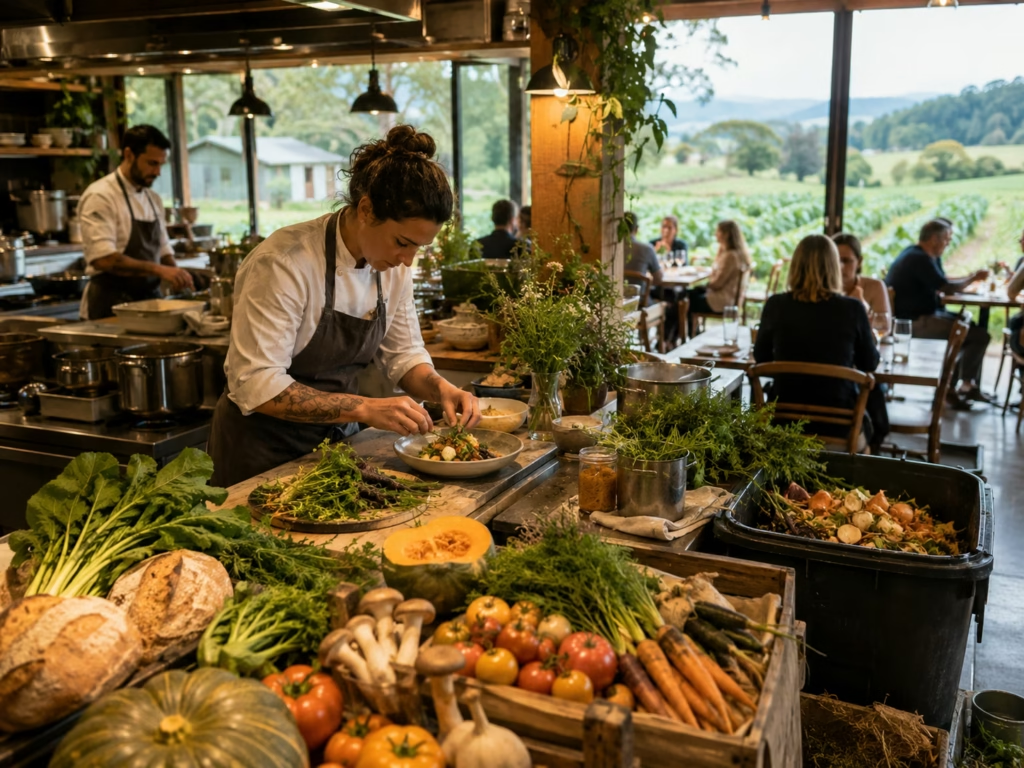
Australia’s culinary landscape has shifted dramatically in the past five years, and nowhere is this more evident than in the farm-to-table movement. Once a niche ethos championed by a handful of progressive chefs, it is now the dominant operating philosophy for restaurants across the continent. In 2026, the Australian food service industry is not merely following global sustainability trends—it is setting them.
The Economics of Local Sourcing
According to the Australian Bureau of Statistics’ latest Food Services Industry report (released March 2026), 68% of full-service restaurants now source at least 40% of their produce from within a 150-kilometre radius, up from 41% in 2022. This represents a structural shift rather than a fad. Chefs have realised that shortened supply chains not only reduce carbon footprints but also improve ingredient freshness and menu flexibility. The ABS data, accessible at https://www.abs.gov.au/, also shows that restaurants prioritising local sourcing report 22% higher customer retention rates than those relying on imported goods.
Case Study: Brae’s Regenerative Model
Dan Hunter’s Brae in Birregurra, Victoria, remains the gold standard, but dozens of smaller venues have adopted its model. In 2025, Brae partnered with twelve regional farms to implement regenerative soil practices, and Hunter openly shares yield data with other chefs. “The myth was that farm-to-table cost more,” Hunter said in a recent industry podcast. “Now we have the numbers to prove that waste reduction and seasonal menus actually increase margins by 8–12%.” This shift has encouraged even mid-tier chains to renegotiate supplier contracts.
Zero-Waste Kitchens Go Mainstream
Zero-waste cooking is no longer confined to fine dining. Melbourne’s Lume, for example, uses every part of the vegetable—peels become stocks, stems are fermented into condiments, and leftover bread is milled into flour. The restaurant’s 2026 sustainability audit, verified by an independent consultancy, showed a 91% reduction in landfill waste compared to 2021. Sydney’s Firedoor has similarly eliminated single-use plastics and now operates a closed-loop composting system with a local urban farm.
What This Means for the Industry
The farm-to-table revolution is reshaping business models. Restaurants that previously competed on price are now competing on provenance. Menu descriptions increasingly list the farm name and harvest date, not just the dish name. Industry body Restaurant & Catering Australia predicts that by 2028, more than half of all new restaurant licences will include a local sourcing clause. The future of Australian dining is not just about what is on the plate, but where every ingredient began its journey.