Australia’s Space Startup Ecosystem Hits Critical Mass in 2026 with Record Funding and Sovereign Ambitions
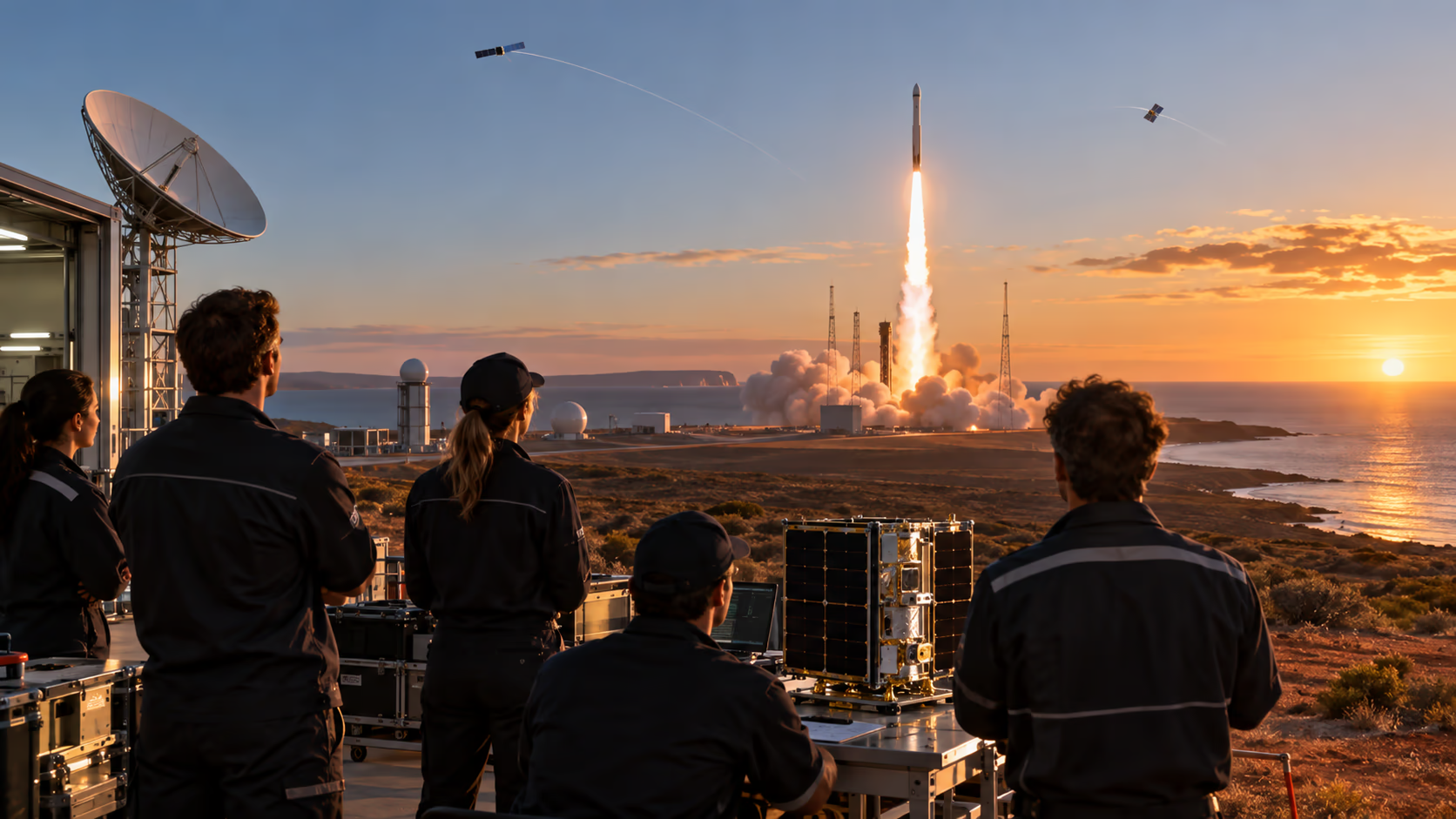
Australia’s commercial space sector has reached a defining moment in 2026. What was once a promising but fragmented collection of ambitious firms has matured into a connected ecosystem of launch providers, satellite manufacturers, and data specialists. The most visible signal of this shift is money. Gilmour Space Technologies, headquartered on the Gold Coast, closed a $217 million Series E round, anchored by a $75 million preferred equity investment from the National Reconstruction Fund Corporation and a matching $75 million from Hostplus. The capital is being used to scale production of the Eris orbital rocket, expand the Bowen Spaceport in North Queensland, and accelerate manufacturing of the 100-kilogram ElaraSat satellite bus. Bowen remains the only Australian spaceport licensed for orbital launches, a fact that gives the company a strategic advantage in the Indo-Pacific.
South Australia’s Southern Launch has also moved quickly. The company raised a $25 million Series A round, including a $10 million contribution from the National Reconstruction Fund, led by defence-focused merchant bank Brindabella and Company. Southern Launch operates two spaceports: the Koonibba Test Range and the Whalers Way Orbital Launch Complex. In 2026, the company supported the world’s first commercial spacecraft re-entry, followed by three additional re-entries, including the Varda W-6 capsule in May 2026. These missions are not publicity stunts. They demonstrate that Australia can host end-to-end space operations, from launch to return, on its own soil.
The Australian Space Agency’s official portal (https://www.australianspaceagency.gov.au/) tracks a sector that now contributes billions to the national economy and supports thousands of high-skilled jobs. The agency’s 2026 data highlights satellites and multi-orbit constellations as core platforms for future growth. This is not simply about prestige. Australia relies heavily on space-based services for communications, navigation, weather monitoring, and defence. Most of those services have historically been supplied from overseas. Developing sovereign capability gives the nation greater resilience, choice, and control over critical infrastructure.
A new generation of startups is filling gaps across the value chain. Myriota, for example, has built a direct-to-satellite IoT network that connects remote sensors without relying on terrestrial mobile coverage. Its technology is used in agriculture, mining, environmental monitoring, and logistics. Other firms are working on advanced materials, space situational awareness, and small satellite propulsion. The Venture Catalyst Space program at Adelaide University’s Innovation & Collaboration Centre selected eight new startups for its 2026 cohort, covering microgravity research, climate risk, and space-enabled data solutions. Since 2018, the program has supported 54 startups, helping them attract up to $135 million in investment. One 2026 participant, THE RED PLAN-ET, is exploring sustainable menstrual care for long-duration space missions, a reminder that space innovation is not limited to rockets and hardware.
The government’s Statement on Space, released in July 2026, reinforces the strategic direction. It outlines a vision for an enduring space sector, with satellites and multi-orbit constellations as central platforms. The statement also signals that sovereign capital will continue to flow into companies that can deliver dual-use capabilities—technologies that serve both commercial and defence needs. For startups, this means access to funding, but also pressure to meet stringent security and reliability standards.
What makes 2026 different from previous years is the integration. Launch providers, satellite makers, IoT network operators, and data analytics firms are now working together rather than in isolation. Gilmour Space’s ElaraSat bus can host payloads from smaller startups. Southern Launch’s spaceports can test and return those payloads. Myriota’s network can transmit data from orbit to remote ground stations. The ecosystem is no longer a collection of isolated innovators. It is a supply chain.
The road ahead is not without risk. Scaling manufacturing, retaining engineering talent, and competing with well-funded American and Chinese launch providers will test Australian firms. But for the first time, the country’s space ambitions are matched by capital, policy, and political will. The startups leading this charge are not waiting for permission. They are building the infrastructure of a sovereign space nation, one launch, one satellite, and one funding round at a time.