How Sovereign Capital Is Rewiring Australia’s Critical Technology Startup Engine

The New Capital Stack Behind Australia’s Deep Tech Push
Australia’s critical technology startup scene is no longer a story about isolated research spinouts. In 2026, it is a story about sovereign capital moving deliberately into quantum, space, semiconductors and defence-adjacent innovation. The National Reconstruction Fund Corporation (NRFC) has emerged as the most visible actor, deploying equity and loans across priority areas that include defence capability, enabling technologies and value-add manufacturing.
The shift matters because critical technology startups often face a financing gap that private markets alone will not close. Deep tech commercialisation is capital-intensive, slow to revenue and heavily dependent on patient investors. Sovereign investment is designed to absorb early risk and attract follow-on capital—precisely the role the NRFC has carved out in 2026.
Silicon Quantum Computing and the Atomic-Scale Manufacturing Bet
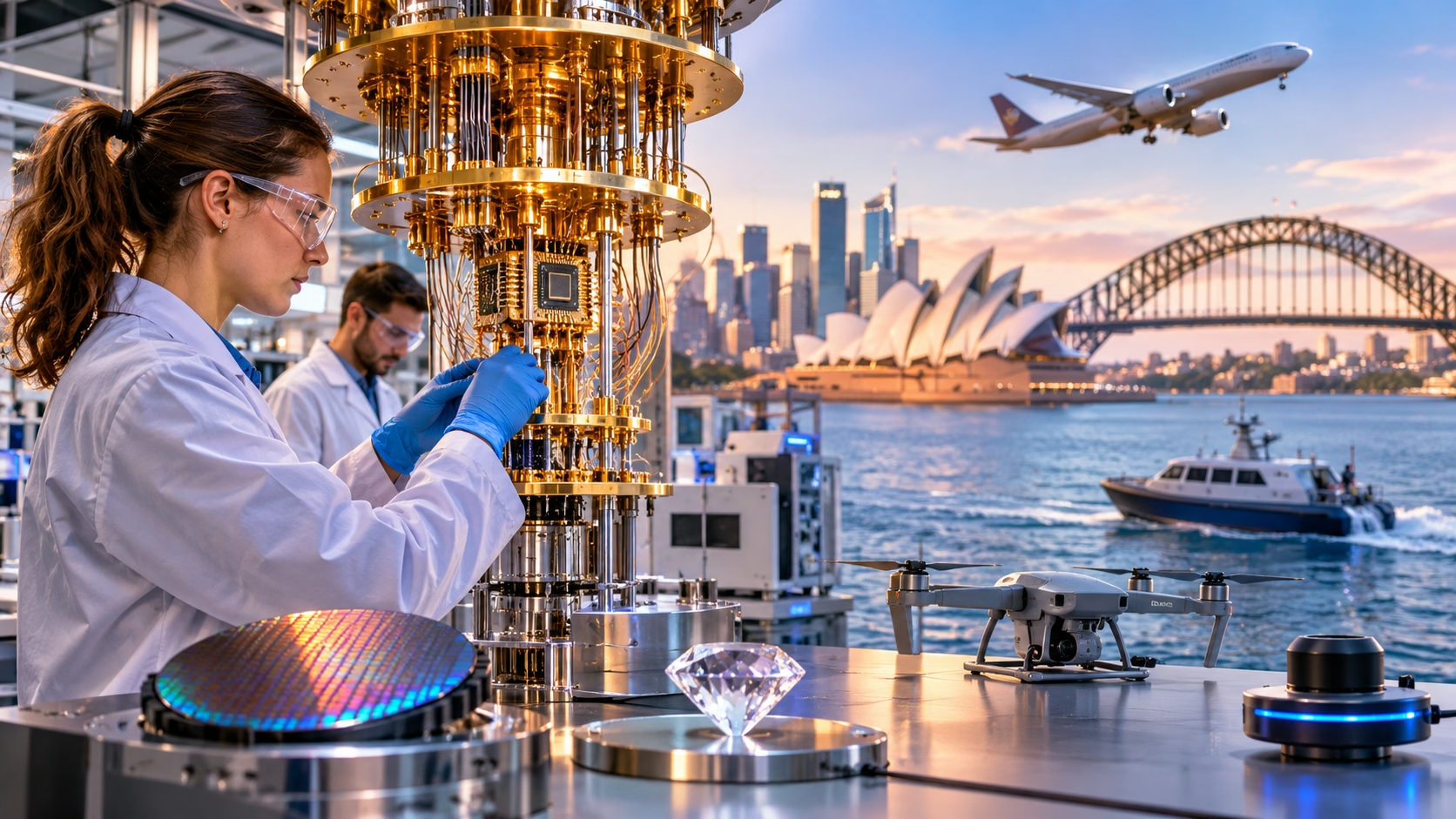
One of the clearest examples is Silicon Quantum Computing (SQC). In June 2026, the NRFC more than doubled its commitment to the Sydney-based company, adding A$40 million on top of an earlier A$20 million investment. SQC is the only company globally capable of manufacturing quantum chips with atomic precision, and its proprietary PAQMan process anchors a sovereign semiconductor manufacturing capability in Australia.
What makes SQC strategically significant is not just the technology but the industrial logic. Quantum chips with atomic precision sit at the intersection of semiconductors, defence and AI. SQC’s rapid design-to-test cycle—under one week—compresses the iteration loop that normally slows deep tech commercialisation. For a national strategy seeking to build sovereign capability in strategic industries, that speed is a competitive asset.
Space Domain Awareness and the Defence-Civilian Blur
The NRFC’s A$10 million equity stake in HEO, a space technology startup spun out of UNSW, illustrates another dimension of the sovereign capital thesis. HEO builds satellite-mounted cameras and AI-enabled software for non-Earth imaging—essentially photographing and characterising objects in orbit. The strategic value is direct: the investment is intended to enable monitoring of 90 per cent of space objects of interest to Australian and allied defence and intelligence agencies.
HEO’s customer base—including the Australian Department of Defence, the Japanese government and the U.S. National Reconnaissance Office—shows how critical technology startups can move from research grant to allied procurement in a compressed timeframe. The dual-use nature of the technology is not incidental; it is the commercial pathway.
The A$500 Million Question: Scale, Procurement and the Valley of Death
The Australian Strategic Policy Institute has noted that the proposed Advanced Capability Investment Fund (ACIF), with up to A$500 million in public capital and a target of at least A$1 billion with private co-investment, is a promising but partial answer. The fund is designed to catalyse private equity into defence capabilities, including AI, quantum and autonomy.
The deeper challenge is not capital alone. Australia has a strong research base and a growing startup ecosystem, but it has historically struggled to move technologies into volume production and sustained procurement. The ACIF’s effectiveness will depend on clearer demand signals from Defence, stronger procurement pull-through and a credible pathway from prototype to contract. For critical technology startups, sovereign capital is necessary—but the strategic industrial system around it is what determines whether the innovation scales.