The $150 Billion Question: Mapping Australia’s Data Centre Investment Supercycle
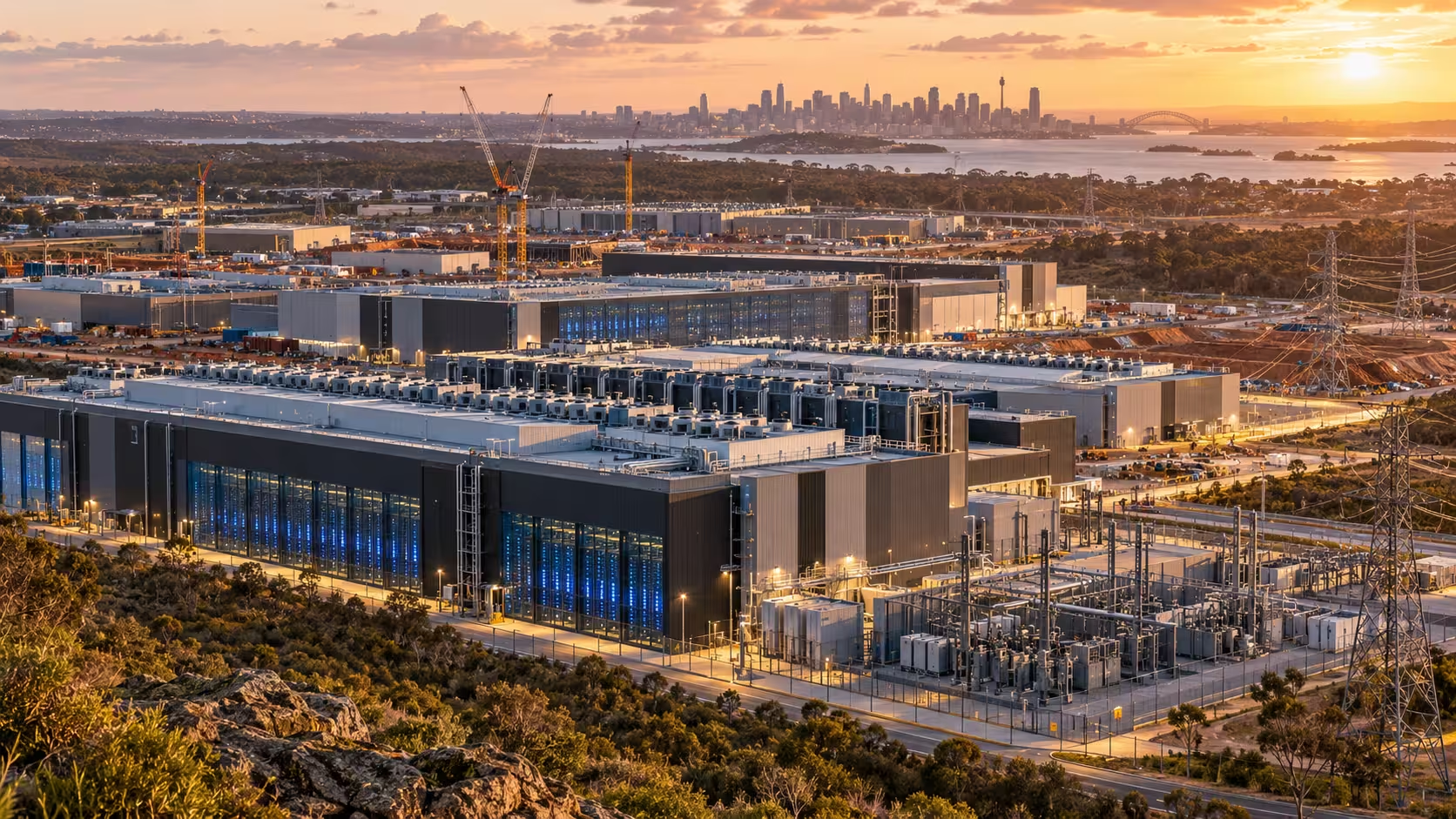
The 6-Gigawatt Revolution: Australia’s Data Centre Pipeline Explained
Australia is in the early stages of an infrastructure build-out that dwarfs anything seen since the mining boom. According to CommBank, the nation’s data centre pipeline now stands at approximately 6 gigawatts (GW) of potential capacity — roughly four times the operational capacity recorded at the end of 2025. If fully realised, industry cost benchmarks suggest this pipeline could represent a total investment value of around $150 billion by 2030.
This is not a speculative forecast. The capital is already flowing. Private capital expenditure in the information, media and telecommunications sector rose by almost 90 per cent in the first quarter of 2026, reaching nearly three times its level a year earlier. CommBank estimates data centres will add around six percentage points to real business investment growth in 2026 and around five percentage points in 2027. As economist Lucinda Jerogin noted, “Without data centres, Australia’s investment outlook would be far more subdued”.
Why AI Changes the Scale of the Build-Out
The driving force behind this surge is not merely the steady growth of cloud computing and content streaming. Artificial intelligence has fundamentally altered the economics of data centre development. Traditional facilities were built to store and serve data; AI factories are built to process it at industrial scale.
This shift explains why individual projects in the pipeline are now several hundred megawatts or approaching one gigawatt — a scale unimaginable just five years ago. Only three of Australia’s 162 operational data centres currently exceed 100 megawatts of capacity. The next generation of facilities will be an order of magnitude larger.
The ASX Stocks Positioned for the Build-Out
For investors seeking exposure, the ASX offers several pure-play and diversified avenues into this theme. NEXTDC (ASX: NXT) is the closest thing to a direct bet on AI infrastructure demand, with pro forma contracted utilisation rising 11 per cent to 740 megawatts. The company’s contracted EBITDA from existing utilisation and forward order book is expected to exceed $1 billion** — more than four times its FY26 EBITDA guidance. The challenge is capital: NEXTDC is carrying roughly **$5 billion of forecast FY27 capital expenditure, and execution will be the key determinant of shareholder returns.
Goodman Group (ASX: GMG) plays a different but complementary role. Data centres now account for 73 per cent of its development pipeline, which was on track to reach $18 billion by June 2026. Goodman’s real edge lies in its secured power bank of 6.4 gigawatts and its ability to convert industrial land into powered data centre sites.
The Bottlenecks That Will Define Winners
Not every announced project will proceed at its proposed scale. According to CommBank, access to electricity, water, grid connections and suitable sites will determine which developments advance. PwC’s Global Data Centre Outlook reinforces this, identifying power availability as the leading consideration, followed by connectivity, security, policy certainty, and community consent.
The scale of the opportunity is immense. PwC forecasts Australia will attract approximately US$703 billion in cumulative AI infrastructure investment by 2050**, with annual data centre capital expenditure rising from **US$16.5 billion in 2026 to US$41.6 billion by 2050. For investors willing to navigate the execution risks, the Australian data centre supercycle represents a generational opportunity to participate in the physical backbone of the AI economy.