Satellite-Guided Tractors and Drought-Proof Seeds: Australia’s Agribusiness Is Engineering a Food-Secure Future
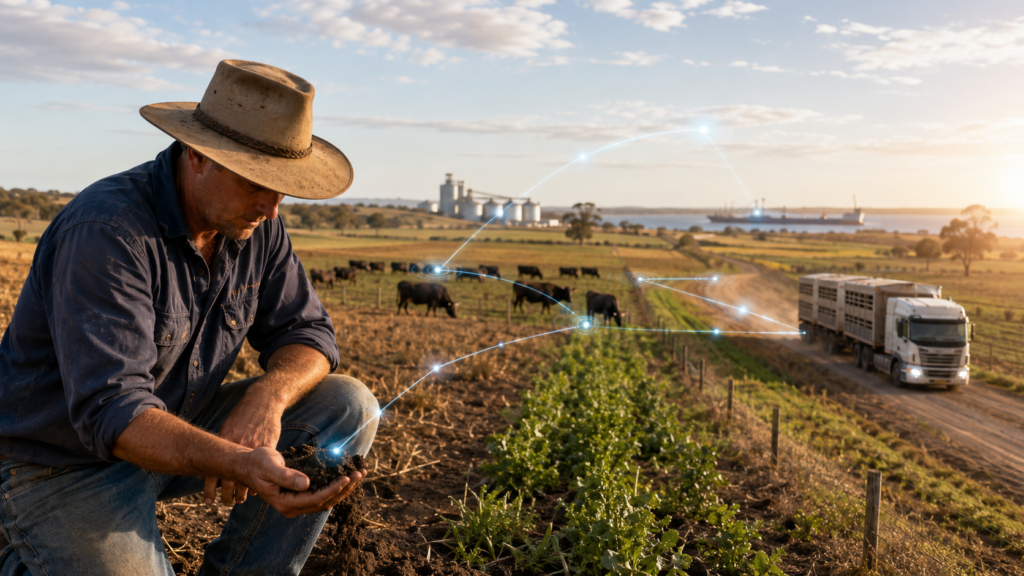
When a broadacre wheat grower near Moree checks crop moisture from a smartphone, he is not just saving water—he is strengthening Australia’s ability to feed itself and its export partners. Australian agribusiness companies are merging satellite intelligence, AI-powered soil sensors and drought-tolerant genetics to create a food system that can withstand extreme climate swings.
The Precision Agriculture Revolution in Australian Fields
Precision agriculture has moved from niche experiment to mainstream practice. GPS auto-steer, variable-rate seeding and drone-based crop health imaging now cover millions of hectares. Industry surveys put GPS autosteer adoption above 85 percent among grain growers, while variable-rate fertiliser spreaders are used on roughly two-thirds of large farms. This shift allows paddock-level decisions rather than whole-farm guesses.
Real-Time Data Is Reducing Input Costs
The financial case is compelling. Satellite imagery from Sentinel-2 and private constellations measures biomass, chlorophyll and canopy temperature. When combined with soil moisture probes, AI platforms recommend exactly how much nitrogen, phosphorus or irrigation to apply. GrainCorp and Elders-backed digital tools, for example, can reduce nitrogen use by 10 to 15 percent without sacrificing yield. Lower input costs improve margins and reduce runoff into waterways, linking farm profitability with environmental performance.
Drought-Proof Genetics: From Glasshouse to Paddock
Drought tolerance is no longer a promise; it is a commercial product. Australian Grain Technologies, CSIRO and university breeding programs have released wheat, barley and canola lines that maintain grain fill under severe water stress. Some varieties use deeper root architecture, while others close leaf stomata earlier to reduce transpiration. In 2026, seed companies are marketing “water-smart” varieties across the Western Australian wheatbelt and Victorian Mallee, regions that suffered repeated drought in the past decade.
Why This Matters for National Food Security
Australia feeds about 75 million people through exports, but domestic food security depends on reliable production in a changing climate. ABARES’ March 2026 Agricultural Commodities Report, available at ABARES Agricultural Commodities Report, forecasts gross value of farm production at A$91.2 billion for 2026–27, with winter crop planting up 3 percent on the previous year. Even so, the report warns that input costs and variable rainfall remain major risks.
ABARES 2026 Production Outlook
The report highlights that broadacre farms adopting precision tools are better insulated against drought. It also points to a 9 percent rise in horticulture exports, driven by almonds, citrus and table grapes. These sectors depend on precise water management and protected cropping, making innovation not just a productivity enhancer but a food security tool.
Making Precision Agriculture Accessible
Smaller farms often struggle with upfront costs. State government rebates in New South Wales and Queensland now cover up to 50 percent of on-farm sensor networks, while agribusiness cooperatives offer shared drone services. This democratisation of technology is critical because 97 percent of Australian farm businesses are family-owned. Without broad adoption, national food security would remain concentrated among large operators.
As more growers adopt satellite-guided tractors, soil sensors and drought-proof seed, the line between digital data and daily food supply becomes inseparable.